 Github
 🚀 Project Case Study: High-Performance Static Portfolio with Serverless CMS Backend
🎯 Project Summary
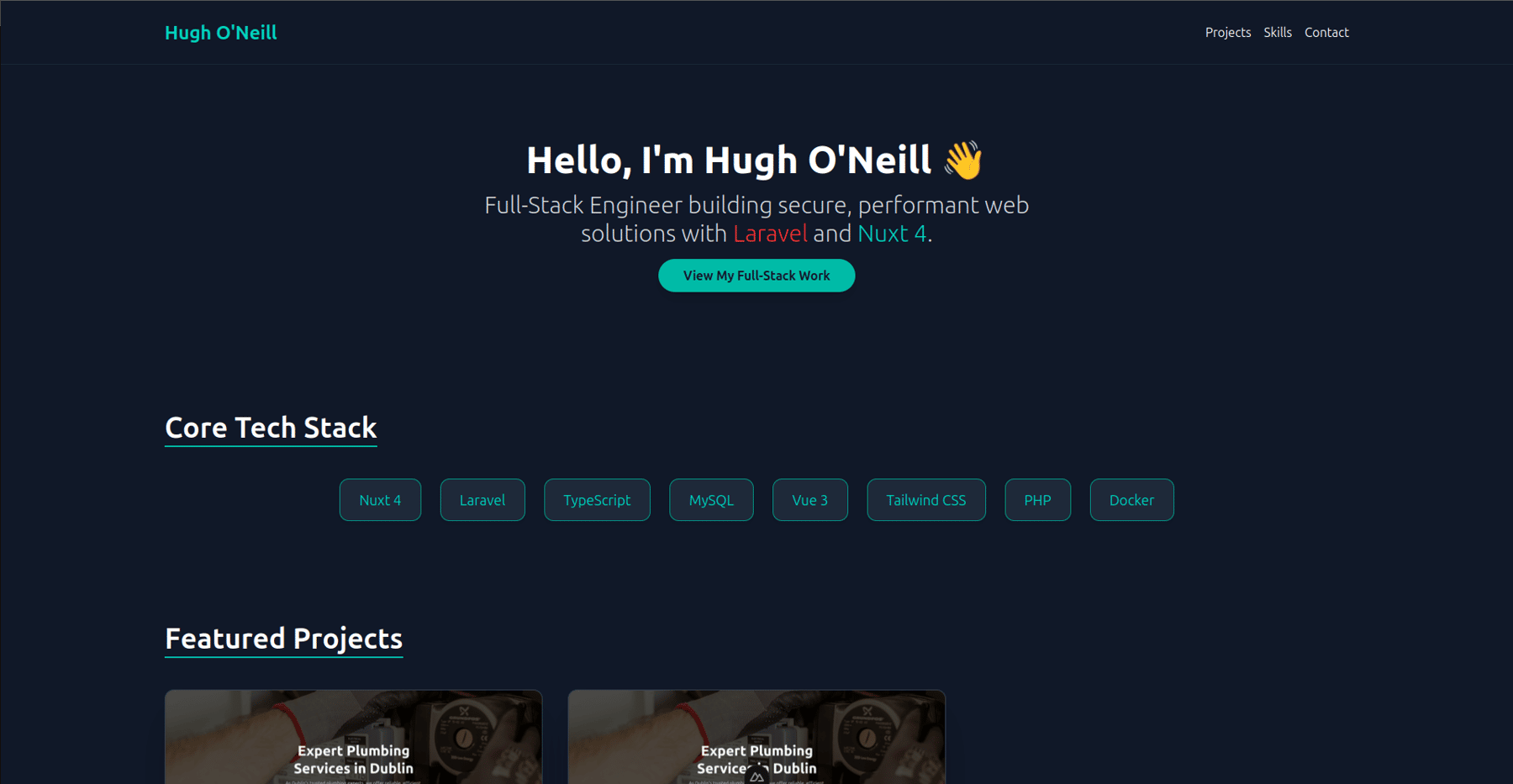
My personal portfolio site to share what I've been up to and help me keep up to date on the latest web technologies with a focus on performance, maintainability, and self-hosted authentication. The site uses Nuxt for a static build, the Nuxt Content module for simplified writing, and Decap CMS for content editing. A key technical challenge solved was implementing a fully self-hosted, serverless GitHub OAuth flow using Cloudflare Workers (via Cloudflare Pages Functions) to authenticate the CMS.
🛠️ Technology Stack & Key Modules
| Technology | Role | Value Proposition |
|---|---|---|
| Nuxt 4 | Frontend Framework / SSG | Provides a robust, full-stack foundation for a static-generated site. |
| Cloudflare Pages | Hosting / CI/CD | Fast, globally distributed static hosting with built-in serverless functions. |
| Nuxt Content | Content Management | Markdown-based content module integrated directly into the Nuxt application. |
| Decap CMS | Headless CMS | Provides a visual, web-based editor for Markdown content (self-hosted). |
| Cloudflare Functions | Backend / Security | Serverless environment used to implement custom GitHub OAuth authentication. |
| Nuxt Image | Performance | Ensures images are optimally sized and served to minimize load times. |
| Nuxt Scripts | Performance | Efficiently manages the loading of third-party scripts (e.g., Google Tag Manager). |
📈 Performance & Optimization Focus
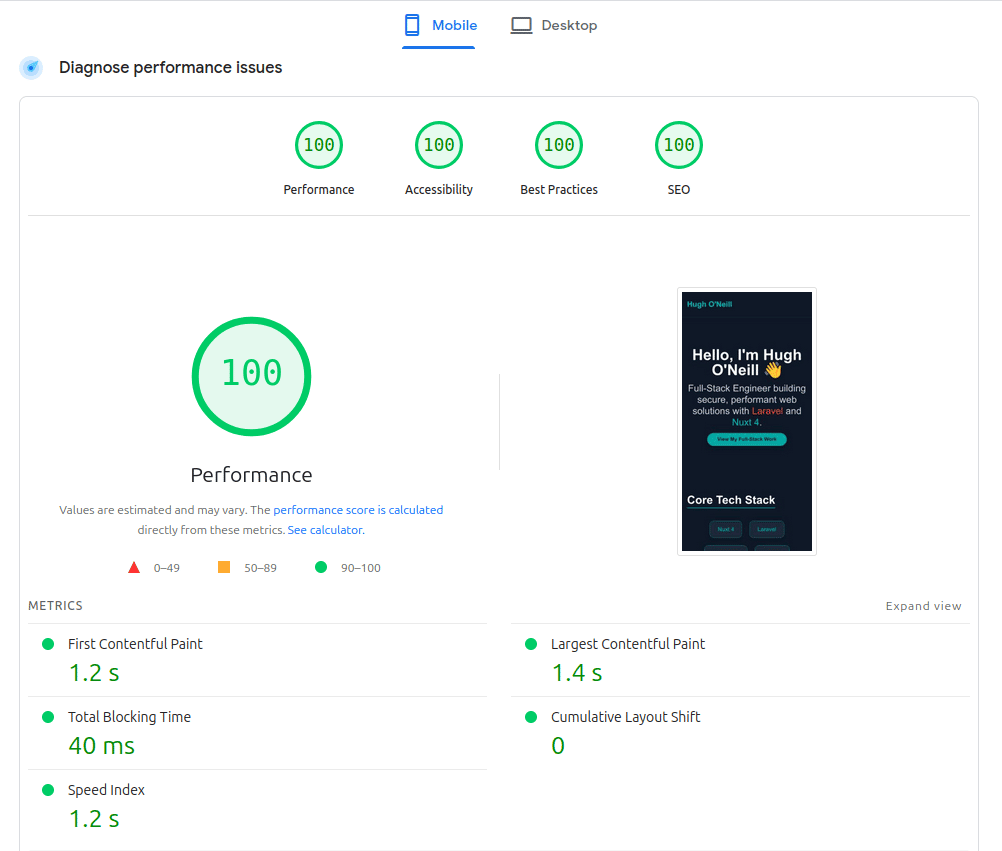
A core objective was achieving exceptional performance scores, leveraging the advantages of static site generation (SSG) and strategic Nuxt modules.
- Static Site Generation (SSG): By deploying static files built during the CI/CD pipeline, the site eliminates server-side processing overhead on page requests, ensuring extremely fast Time to First Byte (TTFB).
- Image Optimization: The Nuxt Image module was implemented to automatically generate different image formats and sizes, serving the smallest possible image based on the user's device and viewport.
- Third-Party Script Loading: Nuxt Scripts was used to ensure scripts like Google Tag Manager are loaded non-render-blocking, preserving a high performance score.
- Zero-Cost Email Solution: Cloudflare's free email forwarding service was used, combined with a manual SPF record update in the DNS settings, to allow sending email via a verified address without the need for a separate, costly email server.
Performance Metrics (Google PageSpeed Insights)
💻 Technical Deep Dive: Self-Hosted Serverless Authentication
The biggest technical challenge was implementing a fully self-hosted solution for the Decap CMS authentication, avoiding reliance on third-party backends like Netlify Identity. This required learning and implementing GitHub OAuth 2.0 using Cloudflare Pages Functions (built on Workers).
Challenge: Implementing OAuth using Cloudflare Workers
The solution required creating an API endpoint that lives within the static site's deployment environment.
- Cloudflare Pages Functions: Backend logic was implemented by placing TypeScript files (
.ts) within afunctionsdirectory, automatically creating serverless API routes (e.g.,/decap/auth). - GitHub OAuth Application: An OAuth App was registered in GitHub to obtain the necessary
Client IDandSecret Key. - Secure Secret Management: The
Client IDandSecret Keywere securely stored as environment variables (Secrets) within the Cloudflare Pages project settings, ensuring they are not exposed in the client-side code.
Key Implementation Steps (Auth Request)
To simplify the OAuth process, an OAuthClient class was created to handle configuration and token exchange. The first function handled the initial request:
- The Cloudflare function is triggered at the custom endpoint (e.g.,
/decap/auth). - It generates the GitHub authorization URL using the stored
Client IDand scope requirements. - It redirects the user's browser to GitHub to authorize the application.
// /functions/decap/auth.ts
export function onRequest(context) {
    const url = new URL(context.request.url);
    // handleAuth utilizes the environment variables (context.env)
    // to build and return the redirect to GitHub.
    return handleAuth(url, context.env);
}
The OAuthClient class was central to abstracting the logic for generating the authorization URL and, crucially, handling the subsequent token exchange in the callback function.
// OAuthClient authorization method snippet
authorizeURL(options: { redirect_uri: string; scope: string; state: string }) {
    const { clientConfig } = this;
    const { tokenHost, authorizePath } = clientConfig.target;
    // Constructs the final URL used to redirect the user to GitHub
    return `${tokenHost}${authorizePath}?response_type=code&client_id=${clientConfig.id}&redirect_uri=${redirect_uri}&scope=${scope}&state=${state}`;
}
This successful implementation allows the Decap CMS to fully authenticate against GitHub, enabling secure content editing without any additional, external server or service cost.
⭐ Skills Demonstrated
- Front-End Development: Nuxt 3, Component Architecture, Content Management (Nuxt Content).
- Performance Optimization: Static Site Generation (SSG), Image Optimization (Nuxt Image), Script Management (Nuxt Scripts), High PageSpeed Scores.
- Serverless Architecture: Cloudflare Pages Functions (Workers), Serverless API Endpoint Creation.
- Security & Authentication: Implementation of GitHub OAuth 2.0 Flow, Secure Secret Management (Cloudflare Variables and Secrets).
- DevOps/CI/CD: Automated deployment via GitHub and Cloudflare Pages.
- Networking: DNS Configuration (SPF records), Email Forwarding.